What Is Hyperautomation and RPA?
Hyperautomation is the automation of automation. Not to mention, it is not a pure workflow automation either, as there are the ingredients of AI, parallelism, distribution of work, and so on. Hyperautomation eliminates the human touch points and brings end-to-end processes together. Companies can optimize entire processes from start to finish. This results in greater efficiency in operation. Robotics Process Automation (RPA) is one of the core technologies in hyper automation. RPA uses software bots to automate mundane, rules-based tasks like data entry, form-filling, and system integration. These bots can work 24 hours a day, seven days a week, and they can process jobs more quickly and more accurately than a human. This is why many businesses are interested in streamlining their processes. So, both of these are foundational future-of-work enablers. They free your organization to focus on higher-value tasks by taking over the mundane.Benefits of Hyperautomation and RPA
The use of hyperautomation and RPA offers multiple advantages that make operations more effective, flexible, and cost-efficient. For example, these technologies streamline routine processes, improving both speed and accuracy.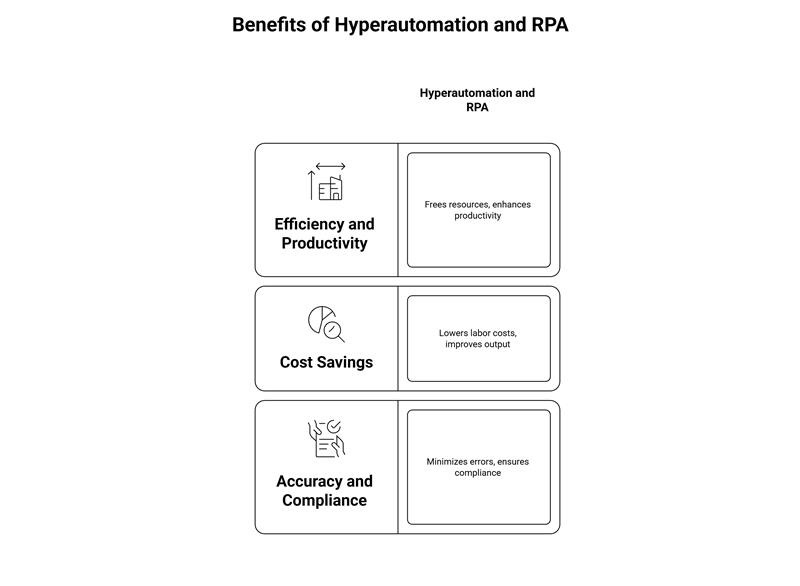
Improved Efficiency and Productivity
Automating the mundane not only frees people up to use their time for more strategic work but also improves productivity. RPA bots can relieve the burden of high volumes of mundane work (which requires a minimal amount of decision-making), such as data input or customer inquiries. This means that people can focus more of their time on decision-making, problem-solving, and innovation. This allows businesses to achieve improved efficiency and expedite their operations.Cost Savings
With RPA and hyperautomation, companies can lower the cost of labor by automating tasks that are done manually. In fact, industry publications report that companies utilizing automation technology have cut costs in business processes by up to 30-50%. Additionally, RPA’s capacity to work 24/7 without breaks or downtime results in improved output while eliminating the need for corresponding increases in overhead.Enhanced Accuracy and Compliance
RPA minimizes human error and ensures that tasks are performed with uniform accuracy. Furthermore, through the automation of compliance activities, such as regulatory reporting and data management, companies can be assured that they are complying with required regulations. This minimizes the potential risk of costly errors or non-compliance. Also read: Designing Secure Distributed Cloud Architectures For Modern Web Applications.Key Trends in Hyperautomation and RPA for 2025
As we move into 2025, several trends are shaping the future of hyperautomation and RPA:AI-Powered Automation
AI and machine learning are significantly enhancing the capabilities of RPA. With AI-powered automation, businesses can not only automate repetitive tasks but also make data-driven decisions. AI is enabling RPA systems to handle more complex tasks, such as data analysis and predictive modeling, leading to smarter and more efficient processes.Automation in Complex Processes
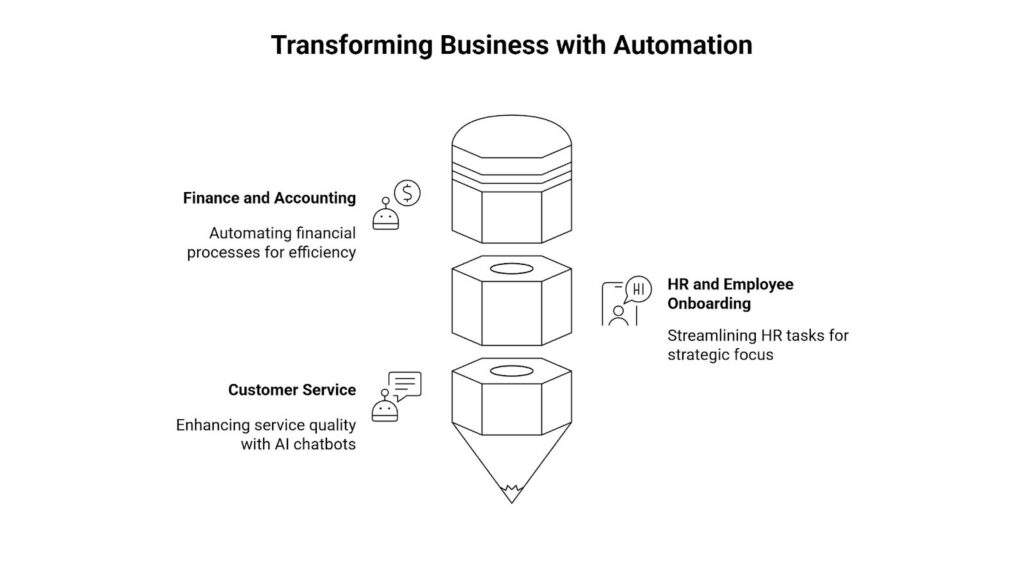
In 2025, we will see hyperautomation extending beyond simple administrative tasks to more complex business processes, such as supply chain management, customer service, and finance. This shift allows businesses to automate even the most sophisticated workflows, improving overall business agility.Integration with Other Technologies
As businesses adopt cloud computing, IoT, and big data analytics, hyperautomation technologies are integrating seamlessly with these platforms. This integration enables businesses to automate processes that span multiple systems, creating a more unified and efficient operation.The Role of Artificial Intelligence in Hyperautomation
AI is a fundamental building block of hyperautomation as it adds expansive capabilities to your business processes. Traditional RPA merely automates basic tasks, while AI can inject the power of automation by enabling systems to see into data, observe patterns, and predict trends. That is to say, not just automated, dumb automation, but feeding AI the tools and autonomy to make its own decisions on data insights. It can help with an even wider range of more complex tasks with cognitive assistance by AI automation. This is all the more interesting when working with unstructured data (content and context-based) and decision-making in real time. For example, AI can forecast demand patterns so companies are better able to handle inventory and their supply chain. Along with RPA, AI is a force multiplier, automating both mundane tasks and more complex decision-making. It improves the speed, granularity, and effectiveness of business processes.Practical Applications of Hyperautomation and RPA in Business
In multiple fields, hyperautomation and RPA are used to increase effectiveness, decrease mistakes, and optimize processes.