
Understand Augmented Reality
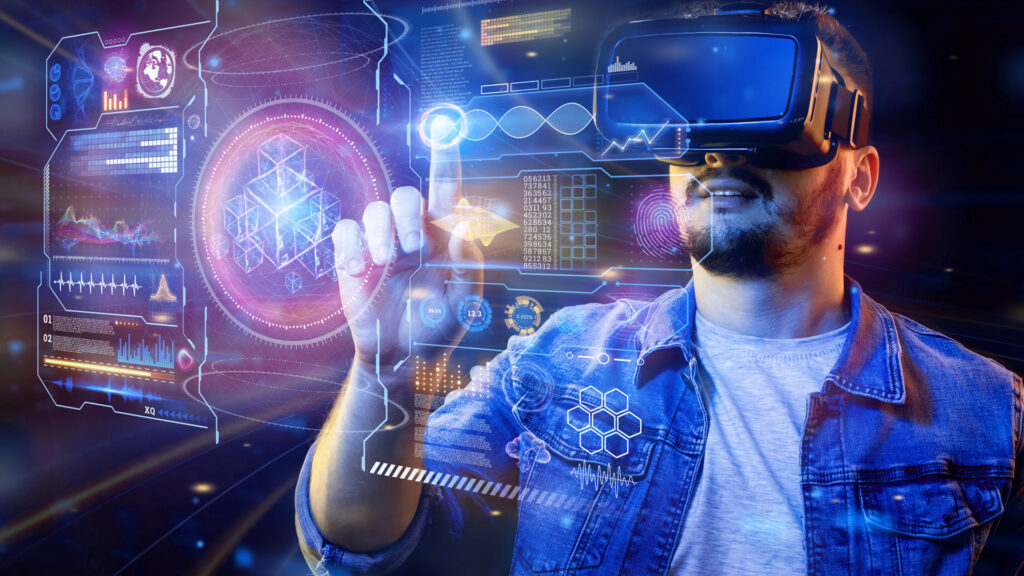
It is a technology that adds elements to the real world. It lets people place digital pictures, videos, or information over what they see around them. Augmented reality can be used for several things, like helping pilots and surgeons with tough jobs or making Snapchat or Instagram stories more fun with filters. As we discussed earlier, augmented reality adds digital content to the real world. Those Snapchat’s fun filters? That’s AR Usually, AR helps fighter pilots fly fast and helps surgeons with complex procedures, it is not always advanced and easy to use.Augmented Reality, Virtual Reality, Mixed Reality & Extended Reality – Know the Difference
Augmented Reality
It adds digital elements to the real world with limited interaction.Virtual Reality
Virtual Reality helps to provide an immersive experience that isolates users from the real world using a headset or headphones.Mixed Reality
It combines AR and VR, so digital objects can interact with the real world, enabling businesses to design elements within a real environment.Extended Reality
This includes all the technologies that improve our senses, including AR, VR, and mixed reality.Types of Augmented Reality
To decide what type of AR technology to use in your business, one should first know what type of AR to use. Basically, there are two types of AR –Marker-based AR
AR uses photo recognition to identify pre-programmed objects. These items act as reference points, assisting the tool in determining where the camera is pointing. The system generally works like this:- The camera switches to black-and-white mode.
- It appears for precise markers.
- It compares these markers to its stored database.
- When it reveals a shape, it calculates in which to vicinity the AR picture correctly.
Markerless AR
This type is extra advanced because it does not depend upon unique markers. Instead:- The device continuously scans its environment.
- It uses complex algorithms to pick out gadgets, colors, and styles in view.
- It combines these visible facts with information from other sensors like GPS, accelerometer, and compass.
- Using all this information, it determines its function and orientation.
- Finally, it overlays AR content onto the real-international view.
How Augmented Reality Works?
Keep reading to know how actual augmented reality works:Camera and sensors
To create augmented reality, you need to capture actual reality with sensors and cameras to collect information on the user’s surroundings. This real-time information improves the experience. Several smartphone applications use your mobile cameras such as Microsoft’s HoloLens uses special cameras. Generally, AR works amazing with 3D cameras like iPhones, because they offer depth information for more realistic and best experiences.Processing
Augmented reality also needs enough processing to identify inputs like tilt, acceleration, position, and depth to create immersive interactions. Fortunately, our smartphones do this without any extra hardware. Because of this, we do not need to mount the AR ceiling anymore. However, it took Google years to make the cameras and sensors small enough to fit into a phone. As AR technology advances, more devices will start using it.Projecting
After capturing real-world information, the AR device projects digital pictures onto the scene. Such projections usually appear on a mobile or multiple screens in a wearable device. You can also project directly onto surfaces, so you don’t require a headset or screen at all.Integrating AR Into Your Employee Training And Education
In the workplace, adding AR to your processes and procedures can help you in many ways. It improves learning and comprehension benefits for your employees. AR learning or training is an educational experience presented via the software on AR devices to assist people in gaining professional skills. This type of training experience can be launched at any time, any place with the right tools and software. Augmented reality for training also provides guidance and support to the employees related to their location, leading to better partnerships and safer and better working conditions in your fields. By improving traditional learning methods, AR techniques can offer various information for better comprehension. Here are some ways your team can use AR will be:- Performance support
- Learning and training modules
- New hire onboarding
- On-demand training opportunities
- Customer service and experience